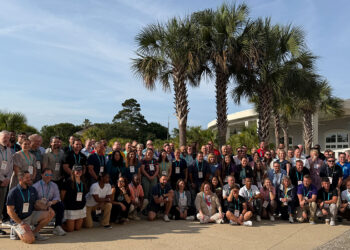



The 2027 Campus Rec Leadership Summit, taking place from June 7-9 in Santa Ana Pueblo, New Mexico, will feature another lineup of education focused on the most relevant challenges facing directors.
From staff development and retention strategies to innovation tools and trends to watch, one conversation at the Summit could save you months of trial and error.
At the 2026 Summit, over 60 attendees shared success stories, obstacles they’ve overcome and potential solutions for navigating future challenges.
Below, find some of the top takeaways from 2026 and get a glimpse into what you may learn next year.
1. AI Adoption is Happening Unevenly
Directors explained how staff are already using AI tools regardless of whether leadership has caught up. The conversation has shifted from whether to adopt AI to how to set guardrails around tools that are already in daily use.
Adoption also isn’t breaking cleanly along the lines leaders expect. Several groups noted generational pushback. Younger staff can sometimes be more skeptical or cautious about AI than their directors assumed, complicating any plan to mandate its use department-wide.
Leaders can try piloting AI tools for specific, low-risk use cases — like drafting or transcription — rather than waiting for a department-wide policy that fits everyone’s comfort level. The focus is less on mastering every platform and more on understanding how AI can support decision-making and efficiency.
2. Structuring Innovation Deliberately
One widely discussed model involved building a deliberately cross-functional innovation team — consisting of IT staff, veteran employees, newer hires, student staff and more — and organizing their work into tiered timelines: low-hanging intermediate wins, short-term physical upgrades and longer-term technology investments.
The structure gave the team room to dream while keeping the work executable, addressing a common failure mode where veteran staff sit on stale ideas, mid-level staff don’t know how to advance a project through bureaucracy and junior staff have strong ideas but lack the political capital to pitch them.
3. The Retention Playbook is Shifting from Pay to Culture
With limited control over salaries and benefits, campus rec departments are relying on workplace experience instead. Two practices came up repeatedly as the mechanism for that shift: treating onboarding as continuous rather than a first-week event and using situational leadership as a shared framework for matching leadership style to each employee’s development stage.
Directors reframed onboarding as an ongoing process tied to role changes, team changes and leadership changes — not a binder handed out in week one. The goal isn’t necessarily to prevent every departure, but to ensure that even employees who leave do so as advocates for the department and the field.
4. Matching Leadership Style to Employee Readiness
Situational leadership — balancing directive behavior (what, when, how) against supportive behavior (listening, coaching, shared decision-making) — surfaced as a shared language for managing a multi-generational workforce. Directors stressed that mismatches in either direction are equally damaging, and that the framework applies to managing up as well as managing down.
Attendees shared examples of both: delegating too early to an experienced new hire who actually needed more coaching and being handed too much autonomy too soon early in their own careers, which felt like being set up to fail rather than supported.
5. Facility Reinvention Through Repurposing Over Expansion
With new construction largely off the table for some organizations, several of the most-discussed facility wins involved repurposing existing space or renegotiating how it’s used, rather than building anything new. Wellness spaces built around massage chairs, natural plants and dim lighting saw far more use than anticipated.
Outdoor facilities saw a different kind of reinvention: one department is shifting an underused outdoor complex into a 50-year lease with the host city, freeing resources to reinvest in a second, more central outdoor space. A simpler but high-leverage move came from a facility rules audit — bringing in a multicultural center to review long-standing policies and flag which ones had quietly become barriers to student participation.
6. Humanized Leadership Works as a Workforce Strategy
Across nearly every session, directors treated vulnerability and accountability not as a soft leadership style but as a deliberate retention and culture strategy — the mechanism by which the other four trends actually get implemented. Directors described normalizing phrases like “that’s on me” as a way to model accountability for staff in real time, and prioritizing face-to-face conversation over email for anything sensitive, including hiring and candidate communication.
Spots for the 2027 Campus Rec Leadership Summit are currently full, but email gracie@peakemedia.com to get on the waitlist. Sponsors can email rico@peakemedia.com for more information.
Thank you to our current 2027 sponsors for making next year’s event possible, including Premier sponsor SportsArt; Diamond sponsors Arly, Brock, EGYM, InBody, Keiser, Matrix Fitness, PLAE, and WellnessSpace Brands; Platinum Plus sponsors Ecore Athletic, Junckers Hardwood, Life Fitness/Hammer Strength; Sasaki and TinyMobileRobots; and Platinum sponsors CannonDesign, Fitness Machine Technicians, Fusion, Human Touch, Paddock Pool Equipment Company, Power Plate, Sourcewell and Trooh.