


From fitness courts to challenge courses, campus recreation departments are exploring how location, accessibility and programming can help increase engagement with outdoor spaces.
Outdoor recreation can help campus recreation departments extend their programming beyond traditional facilities, but adding an outdoor fitness court or challenge course is only the starting point. Leaders must also determine how a space will be used, what resources it requires and how to connect it with the needs of their campus community.
At Oakland University, the Priority Health Fitness Court offers an accessible, low-maintenance place to exercise, but attracting participants to organized programming has proved challenging. At the University of Massachusetts Amherst, the NEST — Nurture, Empower, Support and Thrive — Challenge Course offers multiple ways to engage in outdoor adventure, from independent recreation to facilitated team building.
The two facilities serve different purposes but their experiences highlight a common consideration for campus rec leaders — a successful outdoor recreation strategy depends on more than the space itself. Programming, accessibility, equipment selection and operational resources all influence how a facility fits into the broader campus recreation experience.
From Access to Engagement with Fitness Courts
Oakland’s Priority Health Fitness Court opened in August 2019 through a partnership with Priority Health and the National Fitness Campaign. The campaign aims to make outdoor fitness more accessible by placing a fitness court within a 10-minute bike ride of every American.
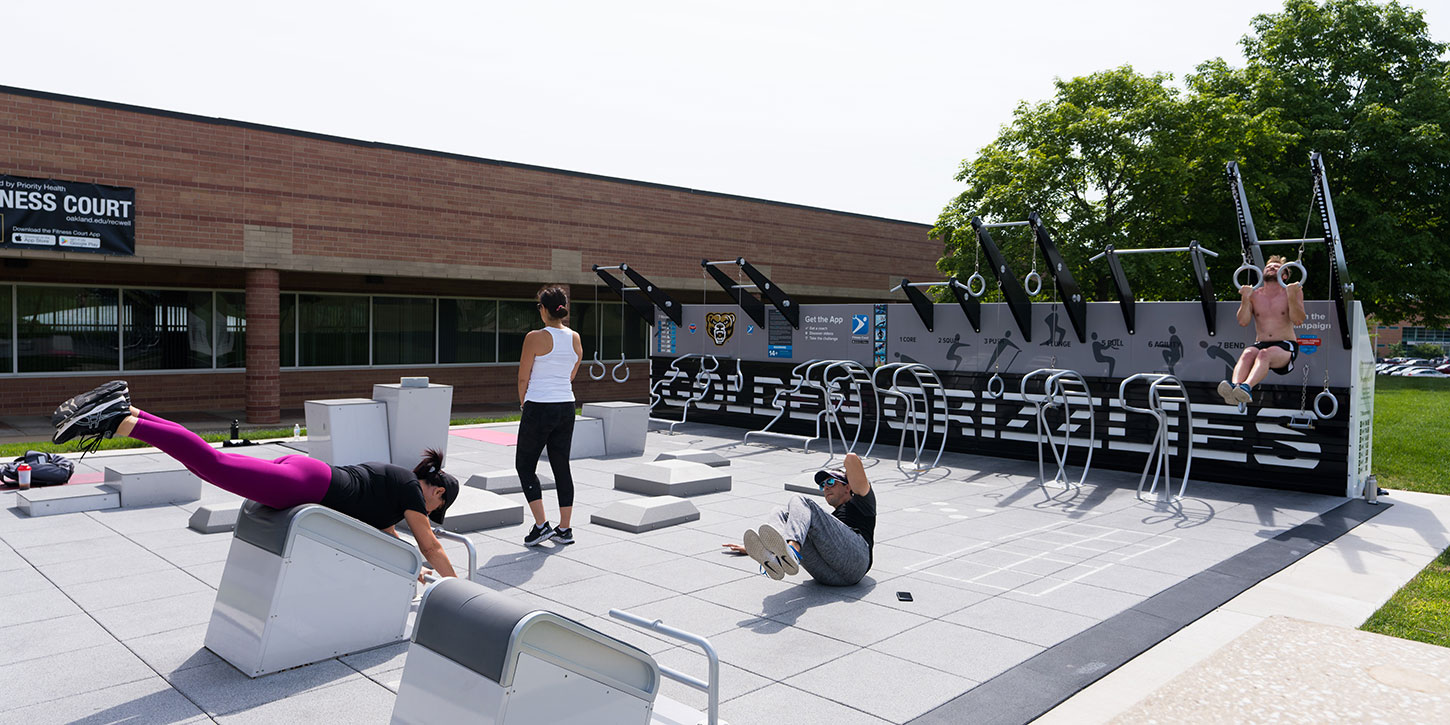
Located outside Oakland’s recreation center, the court features seven stations for bodyweight exercise and is open to students and community members. Its open-access design allows people to use the space without entering the building or registering for a structured program.
That flexibility has shaped how people use the court. Devon Mosquera, the coordinator of Fitness Programs and Services at Oakland, said activity is typically informal, with users incorporating individual stations into their existing routines.
“It tends to be a lot of people who will go and hit the pull-ups or push-ups or just use it to stretch,” explained Mosquera. “They’ll use it as a home base before a run, or we’ll see a lot of families hang out on the fitness court.”
The court also serves as a gathering space for families visiting the recreation center for activities such as swimming, giving the space a role for community members along with students.
Turning access into participation in organized programming has been more difficult. Oakland introduced Fitness Court Fridays during the summer, inviting participants to meet with a personal trainer for a 30-minute session on how to use the stations. Attendance typically ranged from one to two people per daily session.
The department then experimented with different days and times during the fall semester, offering sessions on Tuesdays and Thursdays. The adjustments did little to improve attendance.
Rather than continuing to rely solely on scheduled sessions, Mosquera said the team is exploring ways to introduce programming to people already using the surrounding area.
“If people aren’t coming to us, can we go to them?” asked Mosquera. “If I know that at 5 p.m. all the rental groups come in and everyone’s hanging around the court, can a personal trainer walk out and keep families busy while waiting on another program?”
The idea reflects a practical question for departments considering outdoor fitness: Does the space need more scheduled programming, or would it benefit from being incorporated into activities already happening nearby?
For Oakland, possibilities include having group exercise instructors lead classes outdoors when conditions permit or incorporating the court into the university’s campus walking group. Both approaches could introduce space to people who might not otherwise sign up for a dedicated workout.
Location and climate also affect programming decisions. Although the court is directly outside the recreation center, Oakland’s commuter-heavy campus and Midwest weather can limit opportunities for outdoor activities throughout the year.
Nick Vay, the vice president of commercial sales at BeaverFit, highlighted a related challenge facing many teams: choosing equipment specifically designed for outdoor conditions. Equipment intended for indoor use may deteriorate when exposed to the elements, particularly in wet or humid climates.
“Too often we see facilities take equipment meant for the indoors and place it outside, only to scramble to replace it when it inevitably rusts,” said Vay. “Choose a partner who knows how to do outdoors. Any equipment placed outside should be weather-resistant, designed for outdoor use and have dedicated storage for accessories.”
Your students are ready for Beaverfit. Are you?
Still, Mosquera said the court has required little maintenance. Its materials have held up well to the elements, and the ground markings have remained intact since installation. “It’s definitely a thing that runs itself,” she said. “If you’re able to secure funding, it doesn’t hurt to add.”
For campus rec leaders, Oakland’s experience showcases the importance of distinguishing between access and participation. A facility may offer a convenient place for spontaneous activity without generating the same demand for scheduled classes.
Understanding how people already use the space can help staff determine whether to adjust the programming, its timing or how they promote it.
Challenge Courses Create Multiple Entry Points
At UMass Amherst, outdoor recreation is part of a broader effort to help students build relationships, develop skills and discover new ways to participate in campus life.
The university’s NEST Challenge Course opened in April 2026 in the Orchard Hill area, about a 10-minute walk from the recreation center. The facility grew out of an opportunity to secure funding for a new campus project and expand the department’s adventure recreation offerings.
The resulting space includes the Sky Park aerial adventure course, two tandem zip lines, eight low elements and eight high elements in the Odyssey Course. The Sky Park and zip lines support recreational use, while the low and high elements can be incorporated into facilitated team-building programs.
For Jason Incorvati, the associate director for Programs and Student Development at UMass Amherst, the project was an opportunity to put the department’s emphasis on play into practice.“We’re interested in the importance of play and, as students are coming into adulthood, how to not let go of that,” he said. “Beyond the team-based learning component, how do we create a portion of this that’s more about play?”
That philosophy shaped the inclusion of the Sky Park, which gives students an opportunity to experience the course without participating in a facilitated team-building program.
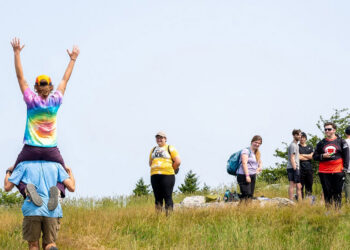
Since opening, the NEST has drawn interest across its recreational and team-building offerings. Carey Lang, the coordinator for Adventure Programs, said open Sky Park sessions on Thursdays and Fridays have filled consistently, sometimes leaving the department unable to accommodate walk-up participants who haven’t registered in advance. Team-building programs have also run regularly, with groups ranging from ten to 50 participants.
One of the team’s primary challenges is helping prospective participants understand what the course offers. The idea of a ropes course can be intimidating, particularly for people who assume participation requires climbing high above the ground.
The department works to communicate that participants can engage with the facility at different comfort levels. The low elements provide opportunities to work together without climbing high, and facilitators can adapt activities to a group’s needs and objectives.
The guiding philosophy is challenge by choice. Participants determine their own level of engagement, with the emphasis on communication, trust and supporting one another rather than completing a particular physical challenge.
Lang recalled working with a group of residential life resident assistants who initially expressed hesitation about the Sky Park. After experiencing the course with their peers, many were surprised by what they felt comfortable accomplishing. The experience prompted a discussion about how people can limit themselves before attempting something unfamiliar.
“It’s really just getting people to work together to define what success looks like for their own particular group,” explained Lang.
Oakland’s approach demonstrates how an outdoor facility can accommodate different goals and comfort levels rather than serving only people who are already interested in high-adventure activities. It also gives staff flexibility to adapt programs around the needs of the group.

Bringing Outdoor Recreation to the Campus Community
UMass Amherst has also developed ways to introduce outdoor adventure to people who may not be ready to visit the course itself.
Through Break the Ice, a portable facilitation kit, staff bring icebreakers and group activities to other campus locations. The introductory program gives participants a lower-pressure way to experience the department’s approach before committing to a longer session at the NEST.
The strategy creates multiple entry points into outdoor recreation. A student might first encounter the program through a ground-based activity, workshop or hike before deciding to try something more challenging. These introductory experiences can help make outdoor programming accessible to people who might not initially see themselves as adventure participants.
According to Chris Livingston, the national sales manager at Bison Inc., portable equipment and multipurpose spaces are great ways to accommodate different user groups while managing capital costs. This approach can help make better use of an existing footprint rather than committing to a space designed around a single activity.
The department’s approach also considers the role outdoor spaces can play beyond formal programming. Lang encourages recreation professionals to think about how these environments contribute to the campus community, including for people who may visit to spend time outdoors rather than participate in an organized activity.
“A piece of advice I would give to other teams is to think about these outdoor spaces as the connective tissue that brings your campus community together,” said Lang.
That perspective has implications for facility planning as well as program development. Gathering areas and informal opportunities to interact can help an outdoor facility become part of campus life, even for people who are not ready to participate in a structured activity.
Planning for Sustainable Outdoor Recreation
The experiences at Oakland and UMass Amherst offer different examples of how campus recreation departments can approach outdoor spaces. Oakland’s fitness court provides an accessible, relatively low-maintenance option, while UMass Amherst’s challenge course supports recreational use, team-building and experiential learning.
Neither model is a universal solution. The right approach depends on a department’s goals, campus environment, available resources and intended users.
Before investing in an outdoor recreation space, leaders should consider several questions: What purpose will the space serve? Who is it designed to reach? How will people discover and access it? What equipment and maintenance will it require? And how can it fit into the department’s existing programming?
The answers can help departments determine whether to prioritize spontaneous use, scheduled activities, facilitated experiences or a combination of approaches. They can also guide equipment decisions, staffing plans and opportunities to collaborate with other campus groups.
Outdoor recreation doesn’t have to start with a large-scale adventure facility or a full calendar of programming. By matching the space to campus needs, paying attention to how people use it and creating different ways to participate, campus recreation professionals can build outdoor offerings that complement their existing facilities and support a broader range of experiences.