
• Subscribe
  • E-Newsletter
  • Media Kit
  • Contact
  • Login
Campus Rec Magazine
  • Sections
    • Columns
    • Facility Development
    • News
    • Operations
    • Programming
    • Rec of the Month
    • Staff Development
    • Well-being
    • Profiles
  • Magazine
    • Current Issue
    • Past Issues
    • Subscribe
    • E-Newsletter
    • Contact Us
  • On-Demand
    • Exclusive Interviews
    • Podcast
    • Webinars
  • Supplier Insights
    • Brand Voice
    • Supplier News
    • Supplier Voice
  • Education
    • CR Leadership Summit
    • CR Base Camp
    • Pickleball Innovators
  • Buyer’s Guide
No Result
View All Result
  • Sections
    • Columns
    • Facility Development
    • News
    • Operations
    • Programming
    • Rec of the Month
    • Staff Development
    • Well-being
    • Profiles
  • Magazine
    • Current Issue
    • Past Issues
    • Subscribe
    • E-Newsletter
    • Contact Us
  • On-Demand
    • Exclusive Interviews
    • Podcast
    • Webinars
  • Supplier Insights
    • Brand Voice
    • Supplier News
    • Supplier Voice
  • Education
    • CR Leadership Summit
    • CR Base Camp
    • Pickleball Innovators
  • Buyer’s Guide
No Result
View All Result
Campus Rec Magazine
No Result
View All Result
Home Operations

Not All Turf Systems are the Same

by Shaw Sports Turf
July 15, 2024
in In Print, Operations, Vendor Content
0
Turf systems
Share on FacebookShare on TwitterShare on LinkedIn

Have you ever wondered why athletes sustain an injury after some extreme maneuvers or plays but walk away from others uninjured? Or why sports performance can be enhanced with minor tweaks to the way an athlete moves?

Biomechanics is the study of human movement as it relates to injury and performance. Understanding biomechanical factors related to injury and performance during sport improves the ability to optimize the performance of turf systems for the athlete.

Injuries occur when forces applied to the body’s tissue exceeds a threshold for damage. In contact injury events, the force on the body is visible — such as during a tackle. However, this is not the case for non-contact injuries where there’s a greater contribution of internal forces than external ones that result in tissue damage.

Understanding Non-contact Injuries

As such, non-contact injuries are thought to be more complex and occur in three stages:

  1. First there’s a predisposed athlete or a person who has an inherent risk for injuries simply based on their anatomical, muscular or biological characteristics such as strength imbalance or previous injury history.
  2. The second stage occurs when the predisposed athlete is exposed to an external risk factor for injury in their playing environment — weather, surface, equipment — or training routine.
  3. The last stage is an injured athlete after the accumulation of tissue damage reaches a breaking point. It’s important to understand the development of non-contact injuries are multifactorial, meaning the level of injury risk is based on a combination of many factors, never just one.

Epidemiology studies in sports medicine are used to identify risk factors for athletic injury. Over the last two decades, 29 epidemiology studies have compared lower extremity injury rates during sport on third-generation artificial turf fields and natural grass. Collectively, 90% of studies examining general lower extremity injuries reported injury rates on artificial turf to be similar or less than natural grass. Similarly, 84% of findings reported knee injury rates for sport played on artificial turf to be similar or less than natural grass and 100% of findings reported hip injury rates on artificial turf to be similar or less than natural grass.

The most uncertainty was at the ankle joint, where findings were split 50/50 on whether injury rates were higher for sport played on artificial turf or natural grass. For any given injury event there are risk factors present, either known or unknown. While epidemiology studies help us understand and learn new risk factors, determining the contribution of each risk factor to an injury event is currently impossible.

How Your Turf Systems Help

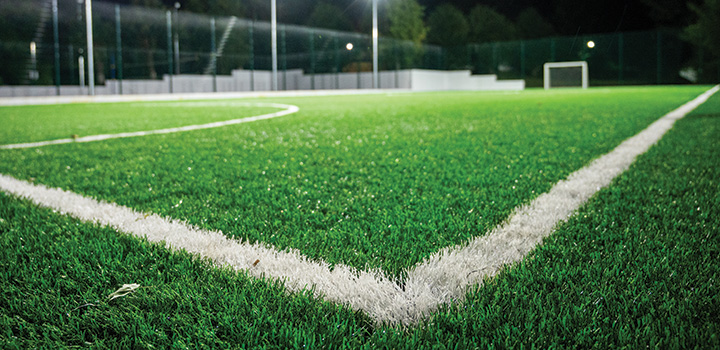
Characteristics of the turf field, like traction and stiffness, can influence sport biomechanics and performance. Artificial turf is an engineered product that can be improved and like other engineered sports equipment and surfaces, optimized for human movement.

However, like sports equipment, not all turf systems are the same. Do your due diligence to find turf companies that use a data-driven approach to designing artificial turf systems.


Trey Brindle, PhD is the director of Research and Innovation at Shaw Sports Turf. At Shaw Sports Turf, Brindle leverages his research experience and sports biomechanics background to enhance current performance assessments and innovations. For more information, visit shawsportsturf.com.


 

Tags: campus reccompetitive sportsfacility operationsintramuralsjuly-august-2024
Previous Post

Q&A with Jason Thornton of Creighton University

Next Post

Maintaining Your Maple Sports Flooring

Related Posts

Q&A with Mikki Showers of Carleton College
In Print

Q&A with Mikki Showers of Carleton College

January 14, 2026
Tradition and Innovation at Yale
Cover Story

Tradition and Innovation at Yale

January 12, 2026
How Campus Rec Departments are Preparing for the Spring Semester
Operations

How Campus Rec Departments are Preparing for the Spring Semester

December 29, 2025
campus recreation technology
Operations

Smarter Systems, Stronger Connections: The Growing Role of Technology in Campus Rec

December 22, 2025
From Metrics to Storytelling: Campus Rec Data Trends Transforming Decision-Making
Operations

From Metrics to Storytelling: Campus Rec Data Trends Transforming Decision-Making

November 24, 2025
Supplier Voice Episode 10: Powering Change — SportsArt Turns Campus Workouts into Sustainable Action
Podcast

Supplier Voice Episode 10: Powering Change — SportsArt Turns Campus Workouts into Sustainable Action

November 17, 2025
Next Post
maple flooring

Maintaining Your Maple Sports Flooring

Get Updates in your inbox

Facebook Twitter Instagram LinkedIn
Campus Rec Logo

The premier business resource for college and university recreation centers.

The Current Issue

January/February 2026

January/February 2026

Browse

  • Home
  • Subscribe
  • E-Newsletter
  • Podcast
  • Media Kit
  • Contact

© 2025 Campus Rec Magazine. Published by Peake Media.

Welcome Back!

Login to your account below

Forgotten Password?

Retrieve your password

Please enter your username or email address to reset your password.

Log In
No Result
View All Result
  • Sections
    • Columns
    • Facility Development
    • News
    • Operations
    • Programming
    • Rec of the Month
    • Staff Development
    • Well-being
    • Profiles
  • Magazine
    • Current Issue
    • Past Issues
    • Subscribe
    • E-Newsletter
    • Contact Us
  • On-Demand
    • Exclusive Interviews
    • Podcast
    • Webinars
  • Supplier Insights
    • Brand Voice
    • Supplier News
    • Supplier Voice
  • Education
    • CR Leadership Summit
    • CR Base Camp
    • Pickleball Innovators
  • Buyer’s Guide

© 2025 Campus Rec Magazine. Published by Peake Media.