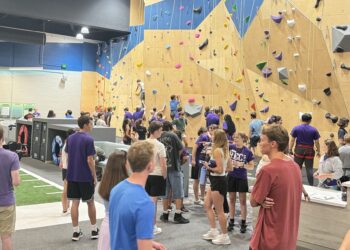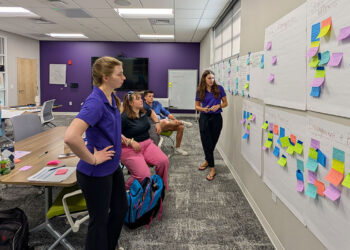


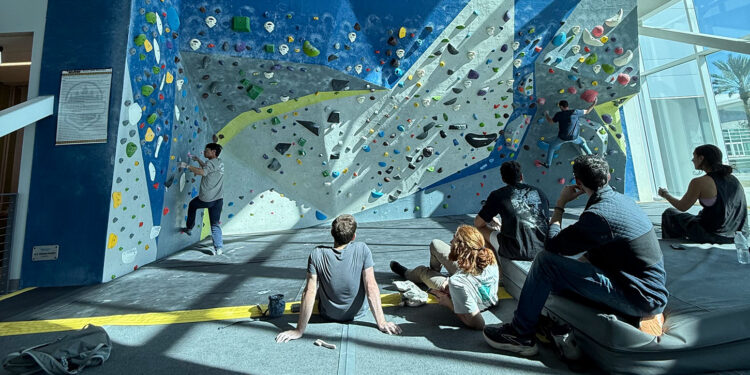
When I arrived at Embry-Riddle Aeronautical University in September 2025, our climbing wall was already closed.
At first glance, the path forward seemed straightforward: repair the damaged areas, replace flooring, reset routes, train staff and reopen. But the physical wall was only the most visible part of a larger challenge. The real work was behind the wall.
We needed to examine how routes were established, how equipment and hardware were selected, how student employees were trained, and how operational knowledge was maintained as students graduated or staff transitioned. We needed current procedures, defined scopes of responsibility, participant access controls, inspection processes, emergency response protocols and a sustainable training system.
What began as a reopening project became a ground-up reconstruction of the entire climbing program, and we aren’t at the end of that process yet. Our reopening has followed a phased model, beginning with controlled bouldering operations and gradually adding complexity as systems, staffing, documentation and participant education are tested.
During summer 2026, our focus shifted toward limited tower activation through auto-belay orientation and competency assessment. Our goal is to transition into belay certification, supervised top-rope climbing and broader tower programming during the fall term.
That distinction matters. Reopening isn’t one moment on the calendar. It’s a process of determining whether the systems behind the program are ready to support the services being offered. It also creates space to ask a larger question: Should student employees continue to serve as the primary route setters for university climbing facilities simply because that’s long been a common campus recreation model?
When Tradition Becomes the Default
Student route setters are deeply embedded in collegiate climbing culture. The model makes sense on several levels. Students bring creativity, enthusiasm, climbing experience and a strong understanding of their peers.
Route setting can provide meaningful leadership development and technical growth. Employing students also helps institutions manage limited budgets while giving students practical experience in an area they care about.
For years, using student route setters has often been treated as a normal and expected part of operating a collegiate climbing wall. But common practice shouldn’t be confused with best practice.
As professionals, we regularly reevaluate how we manage aquatics, fitness equipment, emergency response, youth programming and other higher-risk recreation environments. We update certifications, revise supervision models, adopt new manufacturer guidance and adjust policies when we learn more. Climbing operations deserve the same examination.
Route setting isn’t only a creative exercise. It can involve working at height, operating lifts and ladders, using power tools, selecting and installing hardware, recognizing damaged wall surfaces or attachment points, managing hold orientation, understanding fall zones, controlling route density and protecting the long-term integrity of the climbing structure.
A route setter isn’t merely deciding where the next hold should go. That person is making decisions that shape how participants move, fall, interact with the wall and encounter risk. When the setting is complete, the decisions remain on the wall, affecting every climber who uses it.
The Questions Behind the Qualification
Many institutions require route setters to demonstrate climbing experience. Some provide internal training, pair newer setters with more experienced students or rely on knowledge passed from one student leader to the next. But climbing ability does not automatically equal route-setting competency.
Being able to climb a difficult route does not necessarily demonstrate that someone can select the correct fastener, identify wall damage, manage fall-zone interactions, recognize structural concerns or safely perform technical work at height.
Campus rec professionals may need to ask more precise questions: What formal training has the setter completed? How was competency assessed? Which tasks is the student authorized to perform? Is that authorization documented? Who inspects the completed work? What happens when the most experienced student graduates?
These questions aren’t intended to diminish student employees, but are to ask about the systems we as professionals place around them.
Students don’t establish the institution’s risk tolerance. They don’t write the university’s insurance requirements, approve structural modifications, interpret contracts or carry ultimate responsibility for the facility. We do.
What We Found When We Slowed Down
As we prepared our facility for reopening, we worked with climbing industry professionals to remove existing routes, evaluate the wall, replace the bouldering flooring system and rebuild the climbing environment.
During that process, concerns became visible that weren’t apparent during ordinary daily operations — hardware inconsistencies, damaged wall areas and previous installation practices that required additional review.
The lesson wasn’t to assign blame for past decisions. In many cases, we couldn’t confidently reconstruct what had been done, when it had been done, who completed the work, or what training and supervision had been in place at the time.
That lack of continuity was itself a finding.
Campus rec departments experience constant turnover. Student leaders graduate. Graduate assistants move into professional roles. Coordinators and directors change institutions. If a climbing program depends on a few individuals rather than documented systems, significant operational knowledge can disappear within a semester.
We decided that reopening couldn’t mean restoring the same model and hoping for a different result.
Moving Toward Professional Oversight
For our program, we made the decision to use professional route setters and climbing industry partners for the technical route-setting work.
That choice increased the amount of work required behind the scenes. It meant identifying qualified vendors, reviewing proposals, navigating purchasing requirements, coordinating access, scheduling around facility operations and securing funding. It also meant accepting that routes might not change as frequently as they could under an informal student-led model.
However, frequency wasn’t our only measure of success. Professional route setting brought a broader level of accountability to the process. It also allowed us to establish a clearer separation between technical work and daily student operations.
Our student employees remain essential to the program. They monitor the climbing environment, manage participant access, enforce policies, identify concerns, support equipment processes and communicate with climbers. They’re being trained to recognize hazards and initiate out-of-service procedures when something doesn’t look or function correctly.
But recognizing a concern isn’t the same as authorizing a repair. Monitoring a route isn’t the same as installing it. Supporting a climbing program isn’t the same as assuming responsibility for every technical task within it. Outsourcing specialized work isn’t an admission of failure — it’s an act of professional judgment.
Campus rec professionals can’t personally be experts in every discipline represented in our facilities. Our responsibility is to recognize when additional expertise is needed, bring the right people into the process and prevent specialized work from operating without appropriate oversight.
Student Development Still Belongs in the Program
Removing students from primary responsibility for technical route setting does not mean removing development opportunities.
Students can still provide feedback on route difficulty and accessibility, participate in route testing, learn the principles of movement and route design, shadow professional setters, support documentation and develop within a clearly defined scope.
A student who wants to pursue route setting professionally may benefit more from guided exposure to qualified professionals than from being handed a drill and expected to learn primarily through inherited practices.
The goal should not be to prevent students from developing advanced skills. The goal should be to ensure that advanced responsibilities are accompanied by advanced training, verified competency, appropriate supervision and documented authorization.
That’s a standard we already accept in campus recreation. We wouldn’t allow a strong swimmer to serve as a lifeguard without certification because the student appears capable in the water. Climbing shouldn’t be exempt from the distinction between participation experience and technical qualification.
Rebuilding the Systems Around the Wall
Changing the route-setting model was only one part of the phased reopening.
Before expanding operations, we developed or revised the systems supporting the participant experience: climbing operations procedures, opening and closing inspections, participant orientation, digital access requests, membership approval workflows, capacity limits, equipment checkout procedures, staff positioning expectations, incident documentation, out-of-service procedures, emergency response expectations and staff training records.
We also began replacing attendance-based training with competency-based authorization.
A student employee shouldn’t be considered prepared merely because they attended a training session. Staff must demonstrate that they understand procedures, can identify unsafe conditions, can respond to realistic scenarios and can communicate when an issue exceeds their authority.
Not every employee will automatically be approved for every function. That approach requires more time from professional staff, but delaying a service is sometimes the most responsible operational decision we can make.
Why We Chose a Phased Reopening
There’s pressure associated with any closed amenity. Students want to know when it will reopen. Administrators want progress. Staff members are eager to begin. The longer a visible facility remains unavailable, the more tempting it becomes to set a date first and build the systems around it afterward. We chose the opposite approach.
Our reopening model began with controlled bouldering operations, then expanded into tower infrastructure preparation. During summer 2026, we moved into limited tower activation, introducing vertical climbing through auto-belay orientation and competency assessment before adding the human variables involved in belayed climbing.
At the time of writing, we’re on the edge of moving into belay certification, supervised top-rope climbing and expanded tower access.
Each phase gives us a chance to ask practical questions before adding complexity. Are staff enforcing access consistently? Are participants understanding expectations? Are fall zones being maintained? Are concerns being documented and escalated? Do written procedures hold up during actual operations?
Our goal isn’t simply to reopen the wall. Our goal is to ensure that each added layer of the program is supported by the operational foundation needed to sustain it.
Beginning the Broader Conversation
Our experience is one institution’s experience. Every climbing wall is different, and every department operates with different resources, staffing structures and facility designs.
Some programs may already have developed route-setting systems, formal training pathways, qualified supervision and post-setting inspections. The question isn’t whether every student route setter is unqualified or whether every institution must adopt the same model. The question is whether we have examined our own model closely enough.
Are student route setters being used because the system has been intentionally evaluated and determined to be appropriate? Or are they being used because that is how campus climbing walls have always operated?
This conversation should include campus rec professionals, risk managers, climbing professionals and the students who work in and use these spaces.
The objective shouldn’t be to eliminate student involvement. It should be to build a more deliberate framework around that involvement.
Reopening Isn’t the Finish Line
When our full climbing program relaunches, it’ll be easy to focus on the visible outcomes: new routes, active climbers, expanded hours and renewed energy around the wall.
But the most important changes may never be visible to participants. They’re the procedures stored behind the desk, the training records showing who is authorized to perform which duty, the staff member who knows when to stop activity and the decision to leave part of the facility closed until the necessary systems are ready.
Those choices don’t eliminate risk. Climbing will always involve inherent risk. They do, however, demonstrate that the program is being operated through an intentional, documented and professionally managed risk framework.
We aren’t simply reopening the climbing wall we inherited. We’re building the climbing program that should exist behind it. And perhaps, as campus rec professionals, it’s time for all of us to look behind our own walls.