

How a partnership with BeaverFit helped Michigan State University increase capacity, enhance student wellness and rethink the role of outdoor fitness.
When Michigan State University (MSU) began plans for the Student Recreation and Wellness Center, the goal wasn’t simply to build another recreation facility. Campus leaders wanted to create an environment to reflect changing student expectations while extending recreation beyond the weight room.
That vision called for a partner capable of helping the campus rec department integrate outdoor fitness into its long-term strategy for student wellness, facility use and overall programming.
The result was a collaboration with BeaverFit. Beginning during the design phase in 2020 and continuing today, this partnership provides students with an outdoor strength and functional training environment that complements MSU’s broader mission of bringing engaging recreation to everyone on campus.
Beyond the Building
As campus rec departments face increasing demand for flexible fitness options, many are searching for ways to expand access without expanding their facilities. MSU found success in rethinking the space as a whole.
For BeaverFit, the partnership with MSU represented an opportunity to help a campus create an outdoor training space that could withstand environmental conditions while supporting a wide range of programming.
“Our partnership with MSU stands out because Michigan isn’t known for ideal weather year-round. That’s why they chose BeaverFit when considering an outdoor training space,” said Marianne Buck, the East Commercial Territory Sales Manager for BeaverFit. “They needed equipment that was built for a tough environment while offering plenty of training capabilities, and they trusted us to help them.”
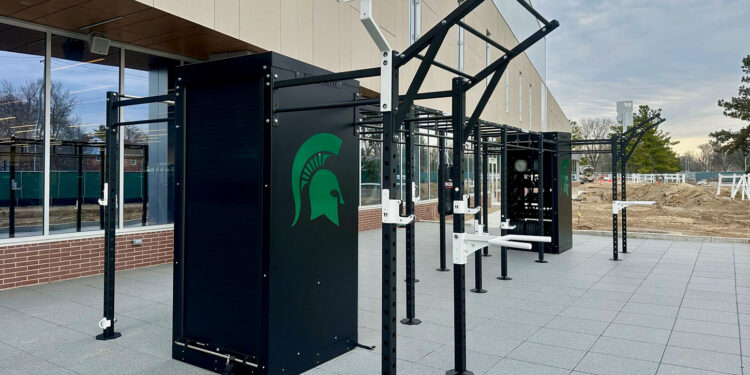
The outdoor space now has three BeaverFit Shred Sheds with multiple lifting stations, secure storage, outdoor accessories and a boxing station.
“During the inception phase, we wanted features beyond what you find in a traditional weight room,” said Marcus Jackson, the director of Recreational Sports and Fitness Services at MSU. “We wanted equipment that would support various styles of training while creating an engaging environment for our users. The BeaverFit partnership provides an avenue to pursue our mission beyond the ‘four walls.’”
A Collaborative Approach
Adding new recreation offerings often means balancing programming goals with limited space and operational realities. Jackson said BeaverFit distinguished itself by treating the project as a collaborative planning process rather than simply an equipment installation, helping the team to create a distinct training environment while maximizing the facility footprint.
“BeaverFit has been an excellent partner throughout the planning, design and installation process,” said Jackson. “They’ve listened to and been receptive to our operational needs, provided helpful recommendations and delivered a solution that complements the goals of our department and the beautiful outdoors.”
Buck said this type of partnership reflects BeaverFit’s broader philosophy of helping campus rec departments increase access to fitness while making better use of existing space.
“Creating a dedicated outdoor fitness space gives students more access to strength and functional training equipment and enables rec centers to increase training space without adding real estate,” said Buck. “Our equipment is specifically built to last outdoors with secure storage and customized school colors and logos so campus rec centers can expand access while fostering a strong sense of community and school pride.”
Supporting Student Wellness
Jackson said the training space serves as an extension of MSU’s commitment to student wellness by providing additional space to exercise outside.
“There’s a large body of research linking outdoor exercise to reduced stress, improved mood and cognitive function,” said Jackson. “This partnership allows us to serve our participants in many ways, starting with physical but extending beyond that into other elements of wellness as well.”
Buck sees that emphasis on wellness becoming increasingly important across higher education. She explained that access to fitness for students is more than just recreation, but about improving mental health and long-term success.
She also noted many institutions continue to face growing demand for recreation space while students juggle busy schedules.
“Outdoor fitness equipment is a practical, scalable solution. Training systems like the Shred Shed give students simple ways to stay active throughout the day,” said Buck. “Additionally, it introduces a new perspective on fitness, combining traditional training with modern thinking about how and where fitness can be achieved.”
A Model for Future Campus Rec Projects
As institutions continue evaluating how to improve student experiences without significantly expanding facilities, MSU’s experience offers a practical example of what can be accomplished through collaborative planning.
Rather than approaching the project as an equipment purchase, the university built a partnership centered on operational goals, student wellness and long-term flexibility.
“I would encourage organizations to view BeaverFit as a true partner rather than just an equipment vendor,” said Jackson. “Don’t hesitate to approach this as a true collaboration where you can dream and create growth for your facilities and opportunities for your users at a fraction of the cost.”
For campus rec leaders navigating space limitations, growing participation and evolving student expectations, the partnership demonstrates that expanding recreation opportunities doesn’t always require building another facility. Sometimes, it starts by looking beyond the walls already in place.