

TinyMobileRobots’ line-painting robots are helping grounds crews keep up with turf care without sacrificing staff or field quality.
When students arrive for intramural games, the field is ready. The lines are painted and the dimensions are correct for whatever sport is about to be played. This work is the product of groundskeepers, facility staff, and student workers who spend hours measuring, marking and painting each layout by hand. This work demands skill and expertise, not just time.
Yet campus recreation teams are increasingly stretched thin. The same staff responsible for painting fields often also care for the turf, repair equipment and maintain facilities.
Eventually, something has to give, whether the quality of the field, the well-being of the staff or everything else on the to-do list. TinyMobileRobots was created so campus rec teams wouldn’t have to choose.
By automating the physical work of line marking, TinyMobileRobots frees up staff to focus on everything else competing for their attention — turf health, facility upkeep and the dozens of other tasks that don’t stop just because a field needs to be painted.
“The robots ease some of the pain of putting lines down for outdoor sports,” said Martin Neff, a product and testing manager at TinyMobileRobots. “At the end of the day, it’s something I would absolutely classify as skilled labor. It’s really hard to do. It takes a lot of the guesswork out and makes it so anyone can go play on a really good field we can provide for that organization.”
This was the driving force behind the company when it was founded in 2015. Created in Denmark by Jens Peder Kristensen and three engineers, the small team transformed a college research project into a global product.
Early company growth centered in Europe, where the team connected with distribution partners to expand the product beyond Denmark, and eventually into the U.S.
After a while, Neff said the team hit a stretch where growth was outpacing everything else — the kind of problem you want to have. That momentum brought in investment, opening the path to building a true global company.
They eventually received some investments, opening up a path to build a global staff.
Now over 100 employees operating out of Denmark, Australia and the U.S., Neff said everyone who works at TinyMobileRobots has one thing in common: passion for the product.
“It’s a really good feeling to know the people you’re working for and with believe in you and want to see this thing grow,” said Neff. “I’ve gotten to watch it grow from double-digit employees globally to what it is now. It’s been really neat to see.”
This rapid growth brought challenges. As a European company venturing into the U.S. market, TinyMobileRobots had to adjust products built for one set of sports to work for another. Early versions of American sports templates, including football and baseball, didn’t always reflect the field dimensions and layouts that U.S. teams expected.
But building out a global workforce rather than relying on small overseas teams has allowed the company to catch those gaps before a product ever reaches a customer.
“We don’t just want to be good enough that a rec league is going to want to use our robots because it makes things easier,” said Neff. “We want to make sure that we’re putting the best possible product on the field for our end users that we can without causing more headaches.”
This culture of collaboration and drive allows the global team to keep delivering a better product with each new sport or feature it takes on.
For campus rec departments specifically, the TinyMobileRobots’ appeal comes down to three key areas: how simple the robot is to operate, how much time it can free up for staff and what that time makes possible for the health of the turf itself.
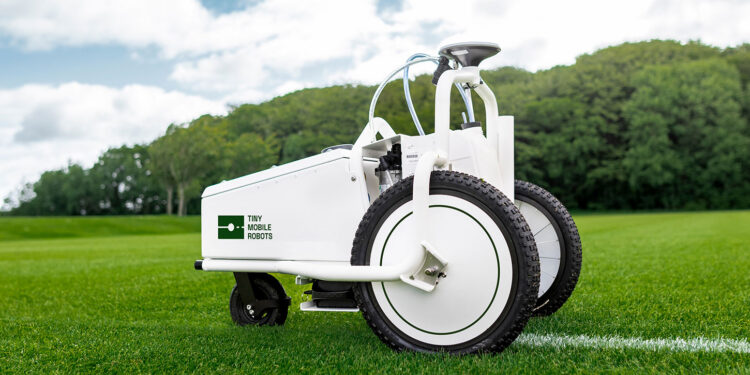
The robots are compact enough for one person to lift and transport. Neff said another employee has fit one in the back of a Prius. Once on-site, the robots can be driven manually with a joystick or sent to a location using GPS.
Staff can set up a field by tracing a GPS overlay or by manually marking reference points, such as the location of a goalpost. From there, the robot can add or remove features, adjust field size, or paint a custom logo. Once a layout is created, it’s saved to a cloud profile, meaning staff never have to remeasure the same field twice.
Its intuitive design helps staff get the job done faster.
“A soccer field can take a two-man crew a couple hours to mark out. It’s a really hard task,” said Neff. “For us, we can put a robot in the hands of one person and have a soccer field painted 25 minutes later. In the meantime, that person who’s operating the unit can now take care of cleaning, mowing or preparing the next field.”
Along with saving time, Neff said the technology changes what campus rec teams can prioritize. Fields no longer need to be repainted simply to keep lines visible between games since layouts are stored and reused. This frees staff to focus on tasks often crowded out, such as consistent mowing, aeration and other turf upkeep.
Looking ahead, Neff said TinyMobileRobots wants to become more than a line-marking solution. The company’s long-term goal is to serve as a broader resource for turf health and care. Eventually, this may include helping customers make decisions about watering, fertilizing and other maintenance based on data the robots collect while they work.
The company is also working to expand where its tech can operate. They’re currently testing alternative GPS correction methods in Europe that would allow the robots to function inside enclosed stadiums, where a clear view of the sky isn’t available.
Neff said the company is exploring uses for the platform beyond sports turf. He pointed to outdoor festivals, where the robot could mark vendor plots and parking lots — both grass and paved surfaces.
“We look at the robot like a little extra employee,” explained Neff. “He’s your helper. He’s always going to be there, and he’s going to make your job a little bit easier.”
For campus rec departments, this means a field that’s ready when students show up, without someone having to sacrifice their time, well-being or everything else on their plate to make it happen.
“We want to see students outside, off screens, playing sports, interacting with the community and with each other,” said Neff. “We think our platform and product can help make that easier for as many people as possible.”