

Through grant funding and energy-generating fitness equipment, SportsArt’s Campus Challenge is empowering students and rec departments to turn sustainability goals into action.
Today, campus recreation is no longer confined to fitness and wellness. Departments across the country are evolving into powerful platforms for student engagement, institutional identity, leadership and sustainability. The students filling these spaces are already searching for ways to make an impact.
SportsArt saw this drive for sustainability and built the Campus Challenge around the momentum.
The Campus Challenge is an initiative aimed at helping bring sustainable equipment and grant funding to rec departments, transforming intention into action and ideas into measurable impact.
“We’re seeing that students today want to do more in any way they can, and we’re also trying to do good for the environment and society at SportsArt,” said Ruben Mejia, the executive vice president for SportsArt Americas. “Now, the challenge is in its third year. It’s grown into a catalyst for change, empowering students, administration and recreation professionals to rethink what’s possible when wellness and sustainability converge.”
For many rec departments, the challenge fills a real gap.
Not every school has the budget of a large university, and the opportunity to win a fully covered cardio package — equipment, freight and installation included — means resources that would’ve gone toward equipment can be redirected somewhere else within the department.
The appeal goes beyond funding. SportsArt’s emphasis on sustainability has made the brand a natural fit for students who see their everyday choices — including where they work out — as an extension of their values.
“When you have a message that resonates with folks, they’re going to spend their money with you and follow your brand,” said Mejia. “We’re not often seen as that corporate machine just looking at profits and the numbers on a spreadsheet. We’re actually trying to do good, which is the same thing students are trying to do.”
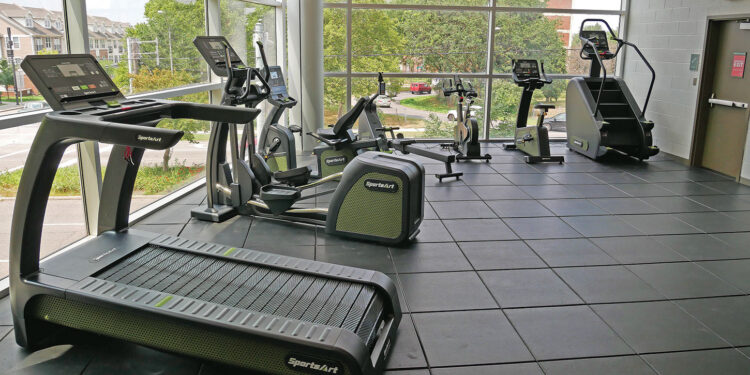
At the center of this mission is SportsArt’s ECO-POWR line of energy-generating cardio equipment. Unlike conventional fitness machines, ECO-POWR equipment converts the energy produced during a workout into usable electricity that can be fed back into a building’s power grid. It creates a direct connection between individual fitness activity and environmental impact, making sustainability something students can experience firsthand every time they step on a treadmill or rower.
This year’s sweepstakes awarded three schools ECO-POWR packages totaling more than $145,000: Pacific Lutheran University (PLU) took home five G690 ECO-POWR treadmills, Catawba College received three G778 ECO-POWR steppers and Macalester College was awarded three G260 ECO-POWR rowers.
Applying for the initiative is relatively straightforward. Students at each school enter for a chance to win SportsArt cardio equipment simply by submitting a form with their name, email and university.
A separate grant application invites schools to go deeper, submitting a 1,500-word proposal outlining how they’d use the funding for sustainability initiatives. Three universities stood out in this year’s grant applications, earning the top spots for funding.
Wayne State University, the third-place grant winner, will create compost and recycling stations throughout the Athletic Center with the goal of implementing zero-waste athletics initiatives.
The second-place winner, Seattle University, is planning on using the grant money to start a small-scale fund to help other student organizations implement green practices by holding events and improving procurement decisions.
At Wilfred Laurier University (Laurier), the first-place winner, sustainability is being addressed from operational and strategic angles. The department plans on spending the funding to help the school advance its own sustainability goals.
“This grant is a catalyst for what we believe can be a transformative shift, not just for Laurier, but for campuses like ours,” said Chad Van Dyk, the manager of Business and Service Operations at Laurier. “By building on initiatives like compostable game-day materials, reduced paper usage, and more efficient resource management, we’re creating a roadmap for sustainability that is both practical and impactful. We hope other universities see what’s possible and feel empowered to take similar steps.”
This ripple effect is exactly what SportsArt had in mind when creating the initiative, but the impact doesn’t stop at the equipment or the grant money. The brand has positioned itself as a connection to the campus rec community, introducing schools with similar sustainability missions to reach other and letting those collaborations grow organically.
Rob Thompson, the associate athletic director for Recreation at PLU, described this interaction from his end. “At PLU, sustainability is something that’s consistently talked about and embedded across departments,” he said. “When we saw the Campus Challenge, it felt like a great opportunity to bring in sustainable, green-friendly fitness equipment that would directly benefit our students and campus community. I think it helped reinforce that sustainability is a shared value across campus, including within our fitness and recreation spaces.”
For Mejia, moments like this are the point. “It’s not about selling a piece of cardio equipment,” he said. “It’s about something bigger.”
The team’s focus sharpened over time. When Campus Challenge first launched three years ago, schools were asked to submit videos showing how they planned to make a difference. Entries were modest, and SportsArt added cash prizes for individual students in year two.
Still not seeing the response they were hoping for, they made a pivotal change this year: moving away from the video requirement, simplifying the entry to a basic form and shifting the incentive away from individuals toward collective impact. As a result, entries surged.
“We’re learning it’s not about the individual, but it’s about the objective and the impact they’re having,” explained Mejia. “Focusing on that is much better than focusing on a single person.”
Looking ahead, SportsArt is thinking about how to expand the program’s reach — potentially bringing in additional partners to grow the prize pool and extend the challenge’s impact even further across campus rec departments nationwide.
“I would love to be able to give away more,” said Mejia. “Whether it’s from SportsArt or a partner who wants to contribute, I want to provide even more to these campus rec centers so they can continue doing all that good work and inspire other students to do the same.”
For SportsArt, this passion and drive for sustainability initiatives are built into the brand. Campus Challenge is proof that a rec center can be more than a place to work out. And with students already showing up ready to make a difference, SportsArt is making sure they have every reason to keep going.