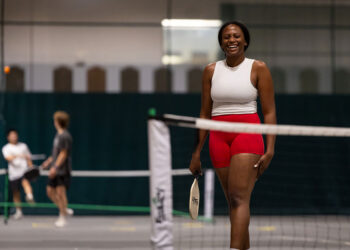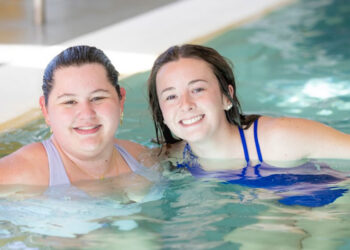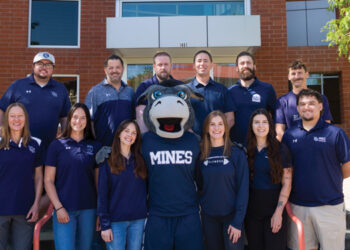



A new adult recreational sports league program helps Brock University bridge the gap between campus rec programming and community engagement.
This spring, Brock University (Brock) Sports and Rec is expanding its community programming with the launch of adult recreational sports leagues open to alumni and local families.
The pilot program, led by Loren Dillane, the Intramural & Community Program coordinator, was designed to bring back alumni and deepen engagement with the Niagara region.
Salée Johnson-Edwards, the associate director of Recreation and Community Engagement at Brock, explained how kids and families regularly engage with youth programming like summer camps and swim lessons, but meaningfully engaging parents and adults in the room is an entirely different challenge.
“Families are showing up, but how do we engage the adults?” said Johnson-Edwards. “Alumni are a huge part of campus. You’ll hear stories of kids who came to camp here, then came to the university and even brought their own kids here. Let’s not just stop with them bringing their kids here — let’s find a way to get them back.”
Developing the Program
The three inaugural sports — pickleball, volleyball and ultimate frisbee — were chosen intentionally. Because each sport is self-officiated, the program avoided the added expense of hiring officials. The sports also reflected current trends: pickleball’s surging popularity, and ultimate frisbee’s reputation as a high-participation, community game.
Scheduling and staffing were other factors for the team to consider. By launching in the spring, when athletic seasons wind down and facility demand drops, the department was able to maximize underused space. The timing also gave the program a chance to test the concept before potentially expanding into busier fall and winter seasons.
The leagues also create new opportunities to involve student staff. The team created two kinds of roles for adult community leagues: lead positions to oversee the program and positions to run day-to-day operations.
Whether with staffing, the number of sports offered or intentional scheduling, starting small was a deliberate and vital choice.
“We’re starting small and scaling,” explained Johnson-Edwards. “Even things like branding and uniforms — these are sports where you don’t necessarily need that right away. We’ll utilize what we already have and then scale as we get operationally bigger.”
To gauge interest and build momentum ahead of the launch, the team put together a mailing list for community members and is ramping up targeted social media outreach. Brock maintains separate channels for community-facing and student-facing programming, giving the department a focused way to reach each audience.
As for what comes next, Johnson-Edwards is cautiously optimistic. Future possibilities include aquatics programming, expanded night offerings and the addition of new sports in year two. The department is also actively listening by polling community members on what sports they’d like to see and staying responsive to what takes off.
Lessons and Advice
For campus recreation departments looking to launch or expand community leagues of their own, Johnson-Edwards offered straightforward advice: just get started. “The opportunities are endless when it comes to community programming within university settings,” she said.
Here are some starting points and key takeaways from Johnson-Edwards:
- Benchmark first. Reach out to other universities with similar programming. Learn from what worked, and just as importantly, from what didn’t. You don’t have to start from scratch.
- Start small, then scale. Resist the urge to launch big. Begin with a manageable number of sports, lean on self-officiated formats to keep costs down and build systems before adding complexity. Branding, uniforms and expanded scheduling can all come later.
- Look for the gaps. Space and time are always at a premium on a university campus. Identify shoulder seasons — periods when facilities aren’t fully booked — to build your program there. Underutilized courts or gyms are an opportunity, not an afterthought.
- Listen to your community. Keep a pulse on what sports and formats people are actually asking for. Johnson-Edwards credits community feedback with helping launch a cricket league at a previous institution — a sport the team hadn’t originally considered.
- Think beyond recreation. Community leagues do more than fill gym time. They create employment for student staff, offer recruiting touchpoints for prospective students, reconnect alumni to campus and build a sense of family that extends well past graduation.
As the leagues prepare for their spring debut, Johnson-Edwards and her team are focused on one thing: showing up, seeing what works and building from there. For a department that’s already made Brock a hub for youth programming, campus wellness and community events, the adult leagues are a natural next step — another way to ensure anyone who walks through the doors of Brock’s facilities, at any stage of life, has a reason to come back.