


How a small campus recreation team built a floating sound therapy program at Northern Michigan University from scratch, and planning considerations teams should know when creating new experiences.
Innovative campus recreation programs aren’t always the result of extensive funding or a large staff. Sometimes, they grow from the need to re-engage students, overcome challenges or from the desire to try something new.
At Northern Michigan University (NMU) Recreational Sports (Rec Sports), those factors led to the development of a unique wellness initiative — a floating sound bath experience designed to help students decompress, reconnect and engage with campus rec in a new way.
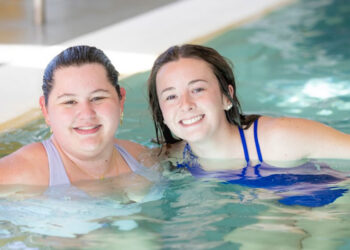
Created by a three-person team, the program invited students to float in the pool while a certified sound therapist guides them through deep relaxation using calming tones and vibrations.
Katie Moe, the assistant director of Campus Recreation at NMU, said the idea emerged after a particularly harsh winter led to 11 snow days and concerns about student engagement.
“I needed something cool to bring people back into the pool who haven’t necessarily participated in our open swimming programs,” explained Moe. “I thought, ‘I’m just going to throw this out there and see if it sticks,’ and it did.”
The inspiration, Moe said, came from experiencing a floating sound bath at a resort in Arizona. While the concept felt somewhat unrealistic for a small university in rural Michigan, the idea continued to resurface as the team searched for other innovative wellness opportunities.
The development process and NMU’s experience offer key considerations and lessons for other departments looking to develop innovative wellness programming at their university to support students beyond traditional fitness offerings.
“I feel like now more than ever, students are more aware and into the concept of holistic wellness, which is awesome,” explained Moe. “We have an obligation to think about all of these dimensions of wellness and not just focus specifically on the physical. This really fits our spiritual and emotional wellness components.”
Bringing the experience to life required extensive behind-the-scenes planning, creative problem solving and careful consideration of a variety of factors.
Finding the Right Fit
One of Moe’s first challenges was identifying someone qualified to provide the sound therapy. She said the team faced the realities of operating in a rural region with limited access to specialized wellness practitioners.
After careful online search and turning to local Facebook community groups, Moe connected with a sound therapist roughly 80 miles from Marquette with extensive experience conducting floating sound baths.
Once the facilitator was secured, planning shifted to operations. In the following weeks, Moe started to coordinate equipment purchases, staffing logistics, facility needs and risk management processes necessary to support the program.
The first consideration was equipment. Pool floats are too noisy and paddleboards too risky, so Moe decided on air mattresses to accommodate the floating participants.
After taking dimensions and finding out how many students could fit in the pool, the team purchased 30 twin-sized air mattresses — 25 for participants and five to account for potential leaks.
Operational logistics were another vital aspect of the program’s development and directly impacted equipment purchases.
The pool lights couldn’t be completely turned off for safety reasons, but students needed something to block the light from lying on their backs and looking up at the ceiling.
Moe ended up purchasing disposable eye masks for participants to use, rounding out the equipment needed for the program. But even beyond the lighting, there were other facility-specific considerations for Moe and her team.
Planning Around the Facility
Since sound therapy relies heavily on controlled acoustics and minimal distractions, environmental management became a critical planning concern.
Moe worked closely with facility operators to temporarily shut down the pool’s air handling system during sessions to minimize background noise.
Residual noise from water fountains, cell phones and people in locker rooms can disrupt the flow of sound. For this, she recommends using staff — or even volunteers — to stand near entrances to mitigate excess sound.
Risk management was another significant part of program planning, and one where staff were necessary. Lifeguards were on duty throughout each session, and staff assisted participants on and off the floating mattresses.
The sessions were held exclusively in the shallow lap pool rather than the diving well, allowing participants to easily stand if needed. Lane lines also remained in the pool to help prevent the mattresses from drifting or clustering together during the experience.
Creating Meaningful Student Experiences
Before officially launching the event, Moe first tested the concept with student employees during Student Employee Appreciation Week. The pilot session allowed staff to evaluate timing, participant flow and operational logistics while also generating marketing content for social media promotion.
The next sessions were intentionally scheduled ahead of finals week as part of broader campus wellness and stress-reduction efforts. Once registration opened, student interest quickly followed, and one session filled almost immediately.
The word-of-mouth and social media promotion were pivotal parts of marketing the program. “It took off really fast once we put it out there, and we got a pretty big bump after our student employees did it,” said Moe. “Having the practice run first really helped. If you need pictures for marketing too, that dry run is really important.”
For Moe and the rest of the Rec Sports team, the success of the event demonstrated how innovative programming can help campus recreation departments create meaningful student experiences while showcasing their broader value to the institution.
She explained how creating inclusive programs where every student can be involved not only helps increase student engagement but also helps aid in recruitment and retention as well.
Moe said she hopes sharing the program’s planning process can help other campus rec professionals feel more confident experimenting with new wellness initiatives at their own institutions, especially if they’re a small team like NMU Rec Sports.
“I feel like the more campus rec professionals can help each other, it’s going to lighten the load we’re all carrying to keep pushing out these new ideas and programs,” she explained. “If more people share what they did and what others should know, we’re just going to keep being awesome.”