

Tips for diversifying revenue streams and what other departments can learn from their approaches.
From bridal exhibitions to spa services, campus recreation departments across the country are reimaging what a profit center looks like. Driven by tight budgets and rising operational costs, many teams are adopting more diversified, intentional funding approaches to build around student fees to create long-term financial stability.
Below, professionals from Marshall University (Marshall) and Texas Tech University (Texas Tech) — along with industry partners from CENTERS — share how they’ve developed new revenue streams, what’s driven the strongest returns and what the future of campus rec profit centers looks like.
Maximizing Existing Amenities
For many departments, some of the most reliable funding comes from better use of existing facilities rather than new programs. At both Marshall and Texas Tech, facility rentals have become a consistent revenue driver.
At Marshall, hosting large local events has brought steady returns while expanding the department’s visibility beyond campus.
“Events like the Huntington Bridal Expo, the St. Mary’s Gala and major basketball tournaments have been successful,” explained Michele Muth, the director of Campus Recreation at Marshall. “Our building can support those events well and it brings more of the community into the facility.”
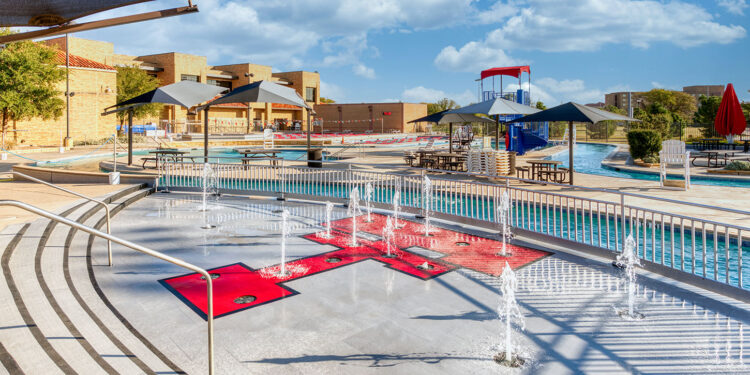
Aquatics facility rentals are the highest-impact revenue generator at Texas Tech, which Jenna Gore, the associate director of Aquatics and Risk Management, attributes to its scalability and high return per reservation.
“Swim lesson programming is also a major contributor, driven by consistent demand and repeat participation across multiple program levels,” said Gore. “Both areas are successful because they meet clear user needs — rentals for group and social experiences, and swim lessons for skill development and water safety.”
The department at Texas Tech also extended this model outdoors. The team started renting its softball complex, turf fields, and campus park spaces to internal and external groups.
Jeff Sessine, the executive vice president of CENTERS, said he’s seen facility rentals become more strategic as teams look to maximize use through community events, training programs and external partnerships.
“Across all these areas, operators are using facility utilization data to better align programming, pricing, and scheduling with both student demand and community opportunities,” said Sessine.
Youth programming has proven to be equally reliable for these universities.
Marshall averages about 80 kids per week through themed summer camps, and Muth said the institution’s West Virginia childcare license adds credibility that’s meaningful to families. Texas Tech has operated a community-wide youth sports camp for several decades.
For both departments, camps are more than a revenue line. They’re a way to build lasting relationships with the surrounding community.
Restructuring Memberships and Pricing Models
Membership sales remain one of the highest-impact revenue streams in campus rec, and both Marshall and Texas Tech have learned that how a membership program is structured can be just as vital as what it includes.
This mindset is also extending beyond traditional memberships to a broader conversation about what programming can realistically be offered for free and what needs a revenue model behind it.
At Texas Tech, the focus has been on reducing friction at every step. Staff show up at new employee orientations and other events where eligible individuals can purchase a membership on the spot. Online renewals and payroll deduction options make it easy for members to stay enrolled.
“The wide range of programs and facilities available to members has also helped sustain strong membership sales,” explained Johanna Valencia, the associate director of Fitness and Wellness at Texas Tech. “With a membership, individuals have access to the Student Rec Center, leisure pool, aquatics center, climbing wall and the outdoor complexes — along with a large number of fitness classes — so there’s something for everyone.”

Rethinking access and value are also shaping how Texas Tech approaches other areas of its operation. Starting in the 2026-2027 academic year, the department is implementing a pay-to-play model for intramural sports — a shift driven by rising costs and the need to fund staff pay increases.
Brett Jackson, the associate director of Sports Programs at Texas Tech, said it’s a meaningful change for a program that’s historically been free. It’s also a change that reflects a broader reality many departments are navigating — as operational costs climb, the question of what students will pay for it is becoming harder to avoid.
Marshall has navigated this same question with mixed results. The department tried charging extra for specialty fitness classes on multiple occasions, but the model never stuck.
“We’ve consistently found free group fitness is a better fit for our community,” said Muth. “People here tend to expect group fitness to be included with membership, and they’re much more willing to pay extra for something one-on-one like personal training. The lesson for us has been that not every revenue idea matches the expectations of your audience, even if it works elsewhere.”
At Marshall, voluntary memberships sit alongside student fees as a core revenue source, with guest passes also growing significantly in recent years.
The department operates under a public-private partnership model, which makes renewable revenue sources especially important. Muth sees membership as an expression of value and believes communicating that clearly is what converts interest into enrollment.
Creative Revenue Streams
Beyond facilities and memberships, both institutions have found meaningful revenue in less traditional areas.
At Texas Tech, the standout has been a full spa model developed within Fitness and Wellness programming. A licensed massage therapist and esthetician staff offer specialty services and packages including facials, cupping, scraping, red light therapy and more.
Another successful addition has been the Wellness Experience, a two-hour reset designed to provide a calming environment. Participants can choose from a range of services, including massage therapy, Normatec recovery sessions, red light therapy and guided relaxation activities.
The department also sells retail spa products at discounted rates and brings chair massage sessions directly to campus events and high-traffic locations to increase visibility.

“Overall, the combination of convenience, collaboration and a strong focus on recovery and well-being has made our spa services one of our most successful and impactful revenue generators,” said Valencia.
At Marshall, creative revenue shows up in retail.
The department’s ProShop has grown substantially since fall 2022, with drink revenue more than doubling from 2023 to 2025. The strategy has been deliberate — stocking flavors not widely available elsewhere, creating urgency through limited offerings and keeping prices approachable.
“We also recently tried a caffeine mystery box with limited-edition drinks, and it sold quickly,” explained Muth. “It reminded me that people really respond to limited items, fun presentation and keeping prices reasonable.”
Both approaches point to the same opportunity: students are already spending on wellness and lifestyle products. Campus recreation departments are well-positioned to capture some of that spending; it’s just a matter of being intentional about how.
The Future of Campus Rec Funding and How to Get There
Marshall and Texas Tech both see campus rec funding moving toward becoming more diverse and intentional.
While student fees will always be a vital part of revenue, Muth stressed the importance of them not being the only answer amid ongoing budget pressure.
Texas Tech echoes this, pointing to continued growth in wellness services, retail and external partnerships as the areas most likely to shape what comes next.
Sponsorships and partnerships, both departments note, remain among the most underdeveloped opportunities in the field. The audience is there and value is being created but the gap is often shown in packaging and communicating it clearly to potential partners.
“Collaborating with larger companies to sponsor programs, events and wellness initiatives could provide sustainable funding while also enhancing the student experience through added resources and programming support,” explained Valencia.
For departments looking to build a stronger revenue model, both institutions offer similar starting points.
Know your market before you build the program. “I don’t think a one-size-fits-all funding model works anymore,” noted Muth. “Some institutions have the resources to rely more heavily on student fees, while others will need to be more creative and entrepreneurial to sustain strong programs and facilities.”
Gore recommends piloting new ideas on a smaller scale, measuring honestly and being willing to walk away from programs that don’t fit your community even if they’re thriving elsewhere.
“It’s also important to be open to trying new and innovative ideas,” said Gore. “Don’t be afraid to step outside the traditional model. Just be sure to plan thoughtfully and strategically before implementation to set your program up for success.”
Finally, Sessine shared how the reality for many departments is that the strongest revenue opportunities naturally align with the mission of creation.
“Wellness programs, youth initiatives, community partnerships, and corporate wellness collaborations all reinforce the goals of health, belonging and lifelong well-being,” said Sessine. “When approached thoughtfully, revenue strategies don’t compete with the mission of campus recreation. They help sustain and expand the programs and experiences that matter most to students and the campus community.
The departments best positioned for the future won’t necessarily be the ones with the biggest budgets or the most ambitious ideas. They’ll be the ones that understand their community deeply, build programs that fit it honestly and treat revenue not as a distraction from their mission, but as what makes that mission possible.