


How University Recreation and Wellness at the University of Arkansas developed a career readiness pilot program that spread to other departments on campus.
While campus recreation departments are major student employers, few intentionally measure how those jobs translate into the workplace after college. University Recreation and Wellness (UREC) at the University of Arkansas set out to change how departments across the school address career development with the UREC Pilot Program.
Michelle Muzzillo, the assistant director of Outreach and Staff Development at the University of Arkansas, said the idea for the pilot came after noticing students couldn’t take time out of their schedules to attend career development events.
“Students constantly talked to us about how they wanted to go but have class or need to work,” explained Muzzillo. “We noticed it was a barrier not to pay our students to do these professional development opportunities. We needed to make more of a real financial investment into their development to get them there, but also to make it accessible for anybody.”
About the UREC Pilot Program
Designed to bridge the gap between campus employment and career readiness, the UREC Pilot Program hired 55 students to be Career-Readiness Associates, compensating them for participating in 10 hours of professional development over the course of one academic year.
An Innovation Fund given to the Division of Student Affairs supported the pilot program. Muzzillo explained how the grant allowed the department to test out the program without investing a large amount of money, not knowing what interest would look like.
While the pilot was initially intended for UREC students only, Student Affairs saw its value and asked UREC to scale it across the division, ultimately involving students from seven departments at the University of Arkansas.
Built around the core competencies of the National Association of Colleges and Employers (NACE), the goal of the program is to help students recognize the skills they’ve gained in campus jobs, articulate those skills on resumes and in interviews, and improve overall career readiness.
The program’s elements are broken down into three sections:
- Four hours of developmental sessions.
- One-and-a-half-hour articulation workshop.
- And four-and-a-half-hours of pilot meetings consisting of orientation, feedback and information sessions.
Student and Supervisor Impact
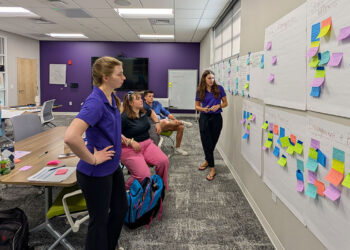
One of the most impactful parts of the program is the articulation workshops, where students take their job description and skills they’ve learned through the position and apply them to long-term career goals and interview questions.
“We wanted students to realize the impact of their employment,” said Muzzillo. “They’re learning communication skills, conflict management, and how to work within a team, all helping them understand how they can apply it after they graduate. That was the biggest impact and the one students feel the most.”
Muzzillo also explained how community building was an unexpected surprise from the pilot. With participants not only from across UREC but also across departments, the program offered a unique experience for students to meet new people and learn about other fields.
While there was some hesitancy among supervisors at first, Muzzillo said they became strong supporters after seeing how NACE skills were being aligned with the program and how UREC was taking on the heavy lifting.
“I think supervisors who tapped into the program were those who really wanted to make their employment experiences transformational,” said Muzzillo. “They were really happy UREC was able to provide it to them and that we took on the financial burden of paying the student to do it too.”
Kristin DeAngelo, the executive director of UREC at the University of Arkansas, said the strong impact of supervisors was unexpected. Many learned how to better help students articulate their jobs, proving the program helped more than just students and reminding supervisors student positions are for more than a paycheck.
Moving Forward
Because grant funding isn’t necessarily renewable, the department is looking for ways to utilize the most impactful parts of the pilot into everyday programming.
One way UREC is doing this is by embedding skill development into existing structures through staff meetings, trainings and day-to-day work. The department offers articulation workshops each semester open to all of campus, and the team said they’ll encourage supervisors to either require students or pay them to attend.
Beyond daily operations, Muzzillo said the UREC Student Employee Advisory Board will continue exploring how it can use the program findings to better the department.
The success of the UREC Pilot Program showcases the importance of providing career-building opportunities for students across departments and offers key lessons for teams looking to enhance professional development.
Aligning NACE competencies with job descriptions or the program is the first step, according to Muzzillo. After this, she recommends integrating paid development into the job, not as an added step.
With the Innovative Fund supporting the pilot, each student was paid around $10 per hour of professional development participation. But even without renewed funding, Muzzillo said it’s a manageable rate for supervisors to build into their budget.
“If a supervisor wanted to encourage professional development possible to do within the budget you have,” she explained. “If you’re strategic about how much you’re asking students to do, I think it can be part of their employment experience. Maybe if you’re a UREC sports official, you’re expected to do two hours of development each semester or something along those lines.”
Lessons Learned
DeAngelo stressed viewing professional development programs as long-term and incremental. “It’s a marathon, not a sprint,” she said. “But we’re already seeing the results which is so exciting.”
UREC has already seen outcomes like higher retention — they saw an increase in student engagement from 16 to 18 months — and better training feedback. Much of this happened because of sustained, layered changes rather than an overnight shift.
Overall, the UREC Pilot Program showcases what can happen when student employment is treated as developmental rather than just a paycheck. By paying students for career-building activities, aligning jobs with NACE core competencies and embedding skill articulation into daily operations, the team not only expanded access to professional development but also strengthened the UREC community.
Even as the formal pilot ends and the division explores a broader model, the impact has already reshaped how campus rec thinks about the long-term impact of on-campus jobs and helping other departments do the same.
Read the full UREC Pilot Program report from the University of Arkansas here.