

Campus rec leaders are rethinking cardio equipment investments by balancing student demand, connected technology, sustainability and long-term value.
Cardio equipment has long been a staple of campus recreation centers but its role is evolving. While treadmills remain a fixture on many fitness floors, departments are reevaluating how much space and investment to allocate to traditional cardio equipment as student interest shifts toward strength training and functional fitness.
However, cardio isn’t disappearing from campus recreation; it’s just being redefined. What matters now is how departments are adapting cardio offerings to align with student expectations.
From replacing underused equipment to exploring connected technology and sustainability initiatives, discover how campus rec teams at Marshall University and Cleveland State University (CSU) are taking a more strategic approach to cardio than ever before.
Reshaping the Cardio Floor
At Marshall, cardio decisions are driven mainly by student preferences shifting toward strength training, free weights and performance-based fitness spaces. As a result, the department has reduced the amount of traditional cardio equipment in the facility in the past three to five years.
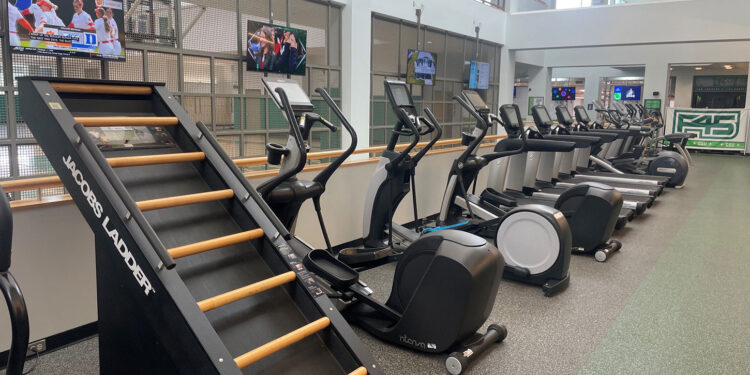
But while strength training becomes more popular, certain cardio staples like treadmills still see consistent usage. According to Mike Weaver, the associate director of Facilities and Operations for CENTERS at Marshall, the piece that’s experienced the most growth is the stepmill.
“Students are increasingly looking for efficient, high-intensity workouts,” said Weaver. “The stepmill provides a challenging cardiovascular workout in a relatively small footprint.”
Stepmills have seen a similar growth at Cleveland State University (CSU). Chris Stewart, the senior associate director of Facility Operations for CENTERS at Cleveland State University, said usage has increased while elliptical use has decreased — all while treadmill use stays consistently above both.
“Treadmills are used six times more than any other type of cardio equipment,” said Stewart. “Therefore, we do our best to invest in these pieces through regular preventative maintenance and equipment replacement whenever our budget allows.”
As student preferences continue to evolve, selecting cardio equipment has become about more than just replacing old machines.
Balancing Innovation and Student Preferences
Manufacturers continue to introduce products with connected technology, personalized workout experiences and features designed to improve engagement.
For campus rec pros, deciding which innovations are worth the investment isn’t always straightforward.
“We’ve found that student preferences don’t always align with what the industry experts say,” said Weaver. “While connected fitness and large touchscreen consoles continue to receive a lot of attention, we’ve actually moved back to traditional consoles on many of our treadmills, stepmills and bikes.”
Although Marshall continues to incorporate connected technology where it makes sense, Weaver said students frequently rely on their own devices for entertainment, music and tracking workouts.
“It’s not uncommon to see a student prop their phone against an expensive touchscreen console and watch content on their own device instead,” said Weaver.
This behavior has directly influenced purchasing decisions. Weaver noted the cost of a single machine with a premium connected console can equal the cost of purchasing two machines with traditional displays. This is a trade-off that often has a greater impact on the student experience.
From a manufacturing perspective, connected technology remains an important part of the industry’s future.
Ruben Mejia, the executive vice president of SportsArt Americas, said operators increasingly expect cardio equipment to deliver personalized experiences through connected tech, performance tracking and individualized programming. At the same time, equipment must be durable, reliable and flexible enough to adapt.
Investing for Long-Term Value
Another top consideration for many campus rec leaders is making purchasing decisions that last far beyond the latest features and trends.
Sustainability, durability and price all factor into determining whether an investment will provide lasting value.
“Sustainability should be viewed as both a responsibility and an opportunity,” said Mejia. “Today’s consumers increasingly want to support organizations that reflect their values. Facilities that integrate environmentally conscious practices into their operations can strengthen both their brand identity and member loyalty.”
Stewart said sustainability is one of several factors CSU evaluates alongside student preferences, price and longevity.
In 2024, CSU was selected as the winner of SportsArt’s Campus Challenge, receiving seven pieces of ECO-POWR equipment.
“These pieces of cardio are eco-friendly as they feed energy back into our facility’s local power grid, offsetting overall power consumption and reducing the facility’s carbon footprint,” said Stewart.
Still, operators caution that every trend should be evaluated through the lens of long-term student demand.
Marshall purchased a self-powered treadmill after students expressed interest in the equipment, but Weaver said enthusiasm eventually tapered off.
“While there was certainly excitement around the equipment initially, the actual usage hasn’t matched the level of demand we anticipated,” explained Weaver. “That experience reinforced the importance of evaluating long-term utilization rather than just responding to trends.”
Letting Data Drive Decisions
Rather than relying solely on anecdotal feedback, both Marshall and CSU use data to guide equipment investments.
Marshall combines equipment usage reports with student surveys to identify trends and better understand what students want on the fitness floor.
CSU uses Ecofit, a platform that tracks equipment utilization, wait times and peak usage periods.
“Ecofit has been helpful for informing decisions when cardio replacement occurs, as it allows us to have concrete data showing what types of cardio equipment is used the most or the least, which ones may have wait times and what times of day certain equipment is frequented,” said Stewart.
Combined with student surveys, the data provides the team with vital information needed to make informed decisions and ensure investments align with students’ behavior and not just assume preferences based on the latest trends.
What’s Next for Campus Rec Cardio Equipment?
Looking ahead, campus rec leaders are continuing to monitor emerging trends while remaining intentional about the future.
At Marshall, a growing interest in Pilates has prompted conversations around reformer equipment, while also watching the rise of HYROX-inspired training. Meanwhile, Stewart said CSU continues to research connected equipment platforms like EGYM as the department prepares for future cardio replacements.
For Mejia, the future of cardio equipment will continue to center on personalization, sustainability and creating experiences that keep users engaged.
“Facilities today are becoming wellness destinations that support physical health, mental well-being, community engagement and environmental responsibility,” said Mejia. “The operators that will stand out in the future are the ones willing to innovate while staying focused on member needs and long-term value.”
The future of campus rec cardio isn’t about adding more machines. It’s about investing in the right equipment, informed by student behavior, thoughtful planning and a willingness to adapt as fitness trends continue to evolve.